Driveways · June 18, 2026 · 6 min read
Pavers vs. Poured Concrete: Which Is Right for Your Minnesota Driveway?
It's the first question almost every homeowner asks us: should the new driveway be poured concrete or brick pavers? We install both, so we have no dog in this fight. Here's the honest comparison we give people standing in their own driveway in Bloomington.
Upfront cost
Poured concrete is the more affordable option upfront in almost every case. Pavers typically run meaningfully higher per square foot because the base preparation is deeper, the material costs more, and installation is labor-intensive hand work rather than a single pour. If the budget is the deciding factor and the driveway is large, concrete usually wins on day one.
Where that math changes is over a 30-year horizon. A concrete driveway that spalls and cracks gets patched, then replaced. A paver driveway gets individual units reset. Total cost of ownership tends to converge, and on smaller driveways pavers often come out ahead.
How each handles freeze-thaw
Minnesota puts driveways through dozens of freeze-thaw cycles a year. Water gets into the surface, freezes, expands about nine percent, and pries the material apart from the inside.
Concrete is a rigid monolith. When the ground under one section moves and the section next to it doesn't, something has to give, and concrete relieves that stress by cracking. Good contractors control it with a compacted base, air-entrained mix and properly cut joints — but the slab is still one big piece.
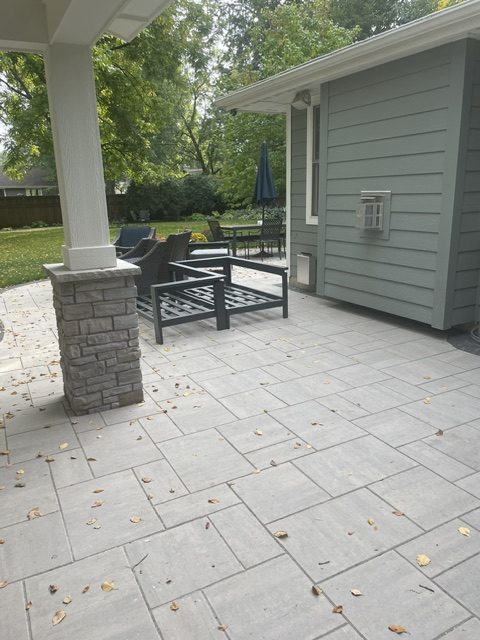
Pavers are a flexible system. Thousands of small units interlock over a compacted aggregate base and bedding sand. When the ground moves, the surface flexes as a unit instead of fracturing. Water drains through the joints and out of the base rather than pooling underneath. That's the single biggest technical argument for pavers in this climate.
Salt and de-icers
Road salt is brutal on concrete. Chloride attacks the cement paste and, on a slab that wasn't air-entrained or sealed, produces the flaking and pitting you see all over the metro by year seven. Sealing every two to three years dramatically extends the life of a concrete drive, but it's a maintenance item you have to actually do.
Manufactured pavers are cured under high pressure and colored through the body, so they're far more salt- and UV-resistant. They shrug off de-icers, and if one ever does get damaged, you replace that one paver.
Snow removal
This is where concrete has a real edge. A flat, joint-free slab is easier to plow and shovel. Pavers can be plowed too — millions of Minnesota square feet are every winter — but the plow shoe should be set slightly high, and a poorly installed paver surface with lippage will catch a blade. Properly compacted work is smooth enough that this is a non-issue.
Repairs and utilities
Pavers win decisively. Need to trench for an irrigation line, a gas service or a new electrical run? Lift the pavers, do the work, rebuild the base, reset the same pavers. The repair is invisible. On concrete, that same job leaves a saw-cut patch with a permanent color and texture mismatch.
Curb appeal and resale
Concrete can be dressed up considerably with stamping, integral color and border bands, and a broom-finished driveway looks clean and intentional. Pavers, though, read as a premium feature — appraisers and buyers notice them, especially when the driveway, walk and patio are designed as one connected space.
So which should you choose?
Our rule of thumb
- Large driveway, tight budget, you'll seal it: poured concrete.
- You want the longest service life with the least chance of cracking: pavers.
- Utilities run under the driveway, or you may change the layout later: pavers.
- You want a decorative look at flatwork pricing: stamped and colored concrete.
- You plow heavily with a truck-mounted blade: concrete is a little more forgiving.
Whichever you pick, the base under it matters more than the surface on top. Ask any contractor how deep they excavate and what they compact — the answer tells you more about how long your driveway will last than the material ever will.
Want a straight answer for your specific property? Call Greg at 952-835-0343. We've been building both across the Twin Cities since 1976, and we'll tell you which one we'd put in our own yard.